Showing posts with label CCTV. Show all posts

Thursday, January 2, 2014

Color signal transmission distance on coax cable for security cameras

Over the past decade of working with CCTV security camera installation contractors, one of the questions that has come forth is how far can signal travel for my color security camera?


After calling other cctv contractors and getting a feel for what the proper answer is, the "rule of thumb" was 500ft. for color and 1000ft. for black and white. Let's put he color to the test.


Now I need to figure out how far color can travel, perhaps a future blog post! Comment below.

"By Mercy Salinas"

Wednesday, June 5, 2013

Direct burial cable for security camera system wiring installation

For most camera wiring installations the pathway of your signal cable is indoors and a small part of that cable run may be exposed outdoors. That's why most cctv camera cables have a general purpose with a sunlight resistant rating to them. But what if you need to extend that cable to a pole far away and you need to bury the cable run?

You'll need a direct burial cable. Let's check out one of our most popular cables for this type of application.


It's important to install a quality cable for a few reasons.

The jacket construction will last for a very long time, the lifetime of a quality cable should last the lifetime of a few security cameras at the location.

Quality copper and a true copper center conductor will allow for a signal to travel a long distance. Since your looking for a direct burial cable your probably doing long cable runs. Low end cables are passing off copper clad aluminum as a bare copper conductor, it's very hard to see but you might find out the hard way. And you wonder why it was so cheap, next thing you know you have a poor signal and the camera image won't come up.

Just a quick tip, if your installing IR cameras at a long distance you probably should install a 24V camera and power supply. You don't want those IR's to turn on in the evening and lose your image signal.

"By Mercy Salinas"  

Wednesday, March 20, 2013

Everfocus IP camera EHN vandal proof serise overview

You know this camera means business as soon as you pick it up, the weight and strength of the metal housing is impressive and it can also handle the pounding of a ten pound sledge hammer.


The screws that keep the enclosure closed are a different pattern so your phillips, flat head or allen pattern won't open it. The cable glad has 3 openings for cable and you can easily attach your conduit and tighten it for a weatherproof solution, you can also unscrew the back knockout and run cable that way.


Another feature I'm really digging is the two way audio and the 3 to 9mm vari-focal lens should have a perfect monitor screen shot if your looking for a wide field of view. I just wanted to vouch for the construction of this camera for a IP weather rated outdoor solution. Check out how to network this camera and I'm sure it's something you can't handle.

"By Mercy Salinas"

Tuesday, March 5, 2013

Replacing your old CCTV system with HD Cameras? Good idea.

Replacing your old analog cameras with new digital HD cameras should be an easy installation, let's check out the High Definition CCTV Security System.

HD cctv is considered by many as a subset of megapixel and is defined by a specific resolution at specific frame rates with a specific aspect ratio. A camera with more than a million pixels is by definition a megapixel camera. The lowest resolution security camera with a megapixel number is 1.3 and provides 1280 by 1024 pixel resolution and is the 1080P camera.


The 720P HD camera provides images that are 1280 by 720 pixels giving you 921,600 pixels and is short of the 1 million mark, so your 720 high definition camera is not a megapixel camera but many people feel it's close enough so they call it a 1 megapixel camera. If your a installation contractor make sure your customer has a clear understanding of this. I've seen it cause issues with the end user after the installation has been completed.

Traditional analog cctv cameras providing 4CIF resolution offers resolution of 704 by 480 pixels (NTSC) or 704 by 576 (PAL) after the signal has been digitized in a DVR that corresponds to a maximum of 400,000 pixels.

When designing a CCTV system two types of coverage areas get talked about, a wide field view and a detailed specific view. In your wide field view 20 to 30 pixels are enough to represent one foot of a scene. For your detailed specific view of certain images such as cash, face identification, factory assemblies, the demand can rise to over 80 pixels per foot. Here's a cheat sheet I keep on hand just to remind me of what pixel count will fit my field of view best for my location.


Still reading? Good, because I have a about a 30 minute presentation from Everfocus regarding HD cctv. Everfocus is a camera manufacture and has been in business for many years providing solutions for commercial locations. Let see what they have to say.


Now that you know you can use your existing coax cable infrastructure your installation is already half way done! Are these HD cctv security cameras also the same as far as the construction? Yeah! Let's check out a couple from our YouTube Channel.


Here's a look at a HD pan tilt zoom camera.


Don't forget that you will need to also install a High Definition DVR for your new HD cameras. If you only need high definition at a couple of locations such as a cash register, hybrid digital video recorders are available to provide you more security at a more economical price.

Now that you have some knowledge about HD cctv are you ready for six times the resolution over traditional analog cameras. I knew it!

"By Mercy Salinas"
 

Wednesday, February 20, 2013

What type of cable should you use for your security cameras?

As you know security cameras are everywhere, have you ever wanted to know what kind of cable they use? The most common cable installed is a "Siamese Cable" that consist of a RG59 coax cable for the camera signal and a 18 gauge 2 conductor cable for the power. The jacket on the "Siamese Cable" covers both of these different cables now making it one cable and easier to pull and install.


When the 2 cables have to split at the security digital video recorder the RG59 cable gets terminated with a BNC male coax connector and the 18/2 cable attaches to a power supply. If you have multiple cameras that need power you might want to consider installing a master power supply to help keep your installation clean and organized.


It's cool how the master power supply has a fuse for each channel in case of a surge in power, you pop the fuse not your camera.

"By Mercy Salinas"

Wednesday, August 10, 2011

Everfocus EN720P19 High-Def CCTV Monitor Video


The Everfocus EN720P19 Monitor is the star of this weeks Product Video Blog.

First, some information on this 19" LCD CCTV monitor:
The Everfocus EN720P19 is a high resolution, 19" display monitor for CCTV systems. It features 720P resolution, with HDMI, BNC, VGA, S-Video, RCA inputs. Great for setting up security camera systems with 4 cameras, all the way up to 16 cameras. You can view all the cameras on the screen at the same time, or display 1 camera full screen for close up viewing. This high resolution monitor works best with the HD DVR's we offer. High definition video has taken over the cable world, and is starting to make a big entrance into CCTV.


Watch the Video!


Features and Benefits of the EN720P19 CCTV Monitor:
- High Definition 720P Display
- HDMI, BNC, VGA, S-Video, RCA inputs
- Wide screen 16:9 aspect ratio
- 3D comb filter with de-interlace & noise reduction
- 500+ lines of resolution
- Easy to order from Discount-Low-Voltage.com
- More...


Related Posts:
1) Video: HD High Definition Security DVR Interview with Annie Wu from Everfocus
2) How To: View Security System DVR with Your Cell Phone - iPhone - Blackberry
3) Ideal SecuriTEST Pro Security Camera Tester
4) Video: DVR Frames Per Second Comparison
5) Everfocus EN220 Security Camera Test Monitor

Monday, August 8, 2011

HD High Definition CCTV Security Surveillance DVR by EverFocus

As we continue to move away from standard definition to HD High-Definition from our Televisions to our phones, the security industry has also begun integrating HD into surveillance applications. We got a chance to speak with Annie Wu from Everfocus about these new HD DVR's and what's so great about them. Take a look:


Capture scenes with stunning HD clarity and get uncompressed full motion MEGAPIXEL DIGITAL video over standard coaxial cable. Attach familiar BNC connectors on the HD CCTV cameras and HD DVR, then display live and recorded images in astounding detail on the HDMI main monitor screen. Get HD 1080p with 6 times the resolution of traditional cameras to deliver the ability to zoom with clarity.

If your looking to upgrade your old analog system, Everfocus has two great DVR options for you. A hybrid solution gives you the flexibility of installing a handful of HD cameras to cover certain areas, while using the rest of the ports for traditional analog cameras. A full HD DVR solution is also offered to cover all your camera locations in High Definition.

Excellent choice for upgrading your current CCTV location because you can use your existing coax cable versus an IP camera solution that requires new cabling and networking. Get Superior 2-Megapixel/1080i and 1-Megapixel/720p quality over existing coaxial cable! HD CCTV provides unmatched clarity and Vivid Detail even while zooming in on live and playback. Call a Discount-Low-Voltage.com sales professional today to get your custom HD CCTV solution started. It's easier than you might think.

(888) 797-3697

Related Posts:
How to View Security System DVR with Your Cell Phone - iPhone - Blackberry
Ideal SecuriTEST Pro CCTV Security Camera Tester
DVR Frames Per Second Comparison Video
CCTV Glossary of Common Terms and Definitions
Everfocus EN220 Security Camera Monitor Test Kit

Wednesday, May 19, 2010

How To View Security System DVR with Your Cell Phone - iPhone - Blackberry

In today's economy, theft is a rising concern for homeowners/business owners. According to the Federal Bureau of Investigation, there were an estimated 6.6 million (6,588,873) larceny-thefts nationwide in 2008. The loss to victims was nearly $6.1 billion. That's a $925 loss on average. Newer technology is helping us pave the way for a safer future, and cell phone's have played a crucial role. With advancements in DVR technology, it is now possible to view your security system remotely. Everfocus has introduced 2 new DVRs that support mobile viewing, the Paragon264 and ECOR264 series. Here's how you set up your DVR for mobile viewing:

1) The DVR must be accessible from the internet via the same process usually employed for DVR remote viewing:
     a. the DVR IP configuration must be consistent with the local network
     b. the router in the system must be configured to forward any traffic for the HTTP port used by the DVR to the IP address of the DVR. Please refer to the DVR User Guide for setting up the DVR network configuration.
2) In the Configuration Menu Network Setting Screen, the new option in the LAN setup "Enable Mobile Viewing" must be checked.

To view, launch the web browser on the mobile device or PC and enter the URL in the form:

http://ZZZ.ZZZ.ZZZ.ZZZ:PPPP/m/live.htm
or
http://dvrddnsname.everfocusddns.com/m/live.htm

where ZZZ.ZZZ.ZZZ.ZZZ is the IP address of the DVR
PPPP is the HTTP port used by the DVR
dvrddnsname is the DDNS name registered with the Everfocusddns.com server

You will be prompted for the login ID and password to access the DVR. Please remember that the ID is case sensitive and the password is numeric.

After entering the ID/Password, choose "OK" or "Log In" and you will see the live view screen. Click on a camera button to select that camera.


Everfocus H.264 DVR's are compatible with many different types of cell phones for remote viewing

Current Mobile Device Verified Compatibility *** (updated 8/3/10) ***

Apple iPhone on Safari
Apple iPhoneGS on Safari
Apple iPod Touch on Safari

T-Mobile/HTC Wing on Opera 10/Windows Mobil
T-Mobile/HTC MDA on Opera 10/Windows Mobil
T-Mobile/HTC HD2 on Opera 10/Windows Mobil
T-Mobile/HTC myTouch on Opera 10/Windows Mobil
T-Mobile/Google G1 on Included Browser

Motorola Droid on Included Browser
Motorola Droid X on Included Browser

Blackberry Bold on Included Browser
Blackberry Curve on Included Browser
Blackberry Tour on Included Browser
Blackberry 8220 on Included Browser
Blackberry 8300 on Included Browser
Blackberry 9000 on Included Browser

Samsung Jack on Opera Mobile 10/Windows Mobile 6.5

(Note: This may not be the complete list. This is just the ones we have verified that will work. If you have an older model DVR, you might be required to Upgrade Your Firmware for cell phone viewing on certain models.)

Related Posts:
Press Release - H.264 Compression Technology
Security Camera System Frames Per Second Comparison Video
How To Create a Low Budget CCTV System
Ideal SecuriTest Pro CCTV Camera Tester

Tuesday, April 13, 2010

Ideal SecuriTEST PRO CCTV Security Tester Video

New product offered at Discount-Low-Voltage.com
The SecuriTEST Pro by Ideal Industries is a great security camera test monitor. It can do things most testers only dream about. Let's take a look at what that is. Enjoy


Ideal SecuriTEST Pro Video

For full product features, description and user manuals, visit the SecuriTEST Pro webpage.

Related CCTV Posts:
Everfocus CCTV Test Monitor Kit
DVR Frames Per Second Comparison Video
CCTV Glossary of Common Terms and Definitions
Smoke Detector Spy Security Camera

Thursday, March 18, 2010

CCTV Test Monitor Kit Video - Everfocus EN220

The Everfocus EN220 cctv test monitor kit is ideal for focusing and adjusting cctv security cameras. This 5.6" LCD monitor is portable and includes a neck strap for hands free use. In today's video, Mercy shows you what to expect when you order the EN220. Enjoy


For full product details, or to order, visit the CCTV Monitor Test Kit page.

Ever used the Everfocus EN220? We're always interested in hearing about your experience with our products. Leave us a comment below or email me and tell me how it went. Maybe we'll put your testimonial on the website. Or better yet, send us some pictures of an awsome install you just finished. We always like putting together "Customer Installations" blogs. Send all pictures to k.atkins@discount-low-voltage.com. Your feedback is always appreciated.

Related Posts:
Featured Product - Everfocus EN220 CCTV Monitor Kit
Smoke Detector Spy Camera Video
CCTV Glossary of Common Terms and Definitions
DVR Frames Per Second (FPS) Comparison Video

Tuesday, March 9, 2010

Smoke Detector with Camera

Smoke Detector Spy Camera

The Everfocus ESD200/ESD100 smoke detector security cameras are a great covert solution for concealed surveillance.The ESD200 comes equipped with 1 color camera and can accommodate 1 more additional camera. The ESD100 has 1 black and white camera, and can hold an additional camera as well, for 360 degree viewing of any room or hallway.  For full product specifications, visit Everfocus ESD200. Let's take a look at what these smoke detector cameras look like. Enjoy


As you can see in the video, one of the great things about the Everfocus smoke detector camera is the low profile look of the housing. A lot of the competitors smoke detector cameras are tall and don't look natural. This one blends in well with the ceiling and looks just like a real smoke detector. What do you think? Leave a comment below.

Related Posts:
CCTV Glossary of Common Terms & Definitions
 DVR Frames Per Second Comparison Video
 Everfocus Micro Mini Color Dome
 Everfocus EN220 Monitor Test Kit

Tuesday, March 2, 2010

DVR Frames Per Second Comparison

Here's an interesting video showing the difference in frames per second (FPS) on a Digital Video Recorder (DVR). Frames per second is the rate at which each frame is displayed on the monitor. 30 fps is real time recording. The naked eye can't tell the difference between 30 and 15 fps, so 15 fps is considered virtual real time. Still taking up to much space on the DVR? Consider a lower fps rate, like 7.5 frames per second, or even 5 fps. This will still give you a fluid picture, while maximizing hard drive space. Let's take a look at what all this looks like. Enjoy


Related Posts:
CCTV Glossary of Common Terms & Definitions
Video Surveillance - Part 1: Introduction
Video Surveillance - Part 2: The Cameras
Video Surveillance - Part 3: Typical Retail Setup

Check out the complete line of CCTV Security Products at Discount Low Voltage. If you still have a question regarding anything CCTV, give us a call at (888) 797-3697

Tuesday, November 17, 2009

Day Night Dome Security Camera Video


Day night dome security cameras are perfect for indoor applications where low light viewing is a concern. In today's economy, it's more important than ever to be protected. One of the best ways to protect your investment from burglary, is to prevent it. According to United States Burglary Statistics, in 2007 a burglary took place roughly every 14 seconds. That means by the time it takes you to finish reading this article and watching the video, 17 burglaries have occurred. That's 6,171 every day. By installing a surveillance security system in your home or business, you chances of a break in are dramatically reduced. Here is a video about the very popular Everfocus ED230 day night security camera. Enjoy


Features:

  • 1/3” Sony Interline Transfer Super HAD CCD
  • 380 TVL of horizontal resolution
  • Special optical low pass filter (inside) for high IR response
  • Low light sensitivity of 0.3 Lux/F=1.2
  • Automatically switches to black & white image when light levels fall below 1 Lux
  • Angle View: 75° range
  • IR Distance: 45 feet (13 meters)
  • Compact size for discreet surveillance
  • Suitable for any indoor IR surveillance

The Everfocus ED230 day night dome security camera is top of the line in performance and reliability. This dome camera uses the Sony 1/3" chip and has 380 TVL (television lines of resolution). We do have the optional high resolution version available, which has 480TVL (Everfocus part # ED330). They both run off of 12V DC power and have a 4.3mm lens. One of the greatest features about this dome security camera though, is the small rubber boot on the end of the lens. This prevents unwanted glare into the lens that you would typically get from some of the lower end IR dome cameras. These day night dome cameras are available with either a black or white base, depending on your application and have an IR distance of 45 feet, which should be more than adequate for most indoor uses. To order, or get more product specifications, visit  Discount-Low-Voltage.com
Or give us a call at (888) 797-3697

Thursday, November 12, 2009

IR Bullet Security Camera Video - ECZ230

IR bullet security cameras are a great choice for your home or small business. They can be mounted inside or outside, offer discrete surveillance, and have a great picture. With 14 infrared LED illuminators, this camera can see in complete darkness. As soon as a light gets turned on, the illuminators turn off and the camera functions as a regular color camera. In addition, it weights under 1 lb and is only 2" wide by 3.1' deep, making this a very versatile security camera. Great quality and a great price make this our best selling IR camera by far. Take a look at the video.


Features:
- 380 TVL of horizontal resolution
- Electronic Shutter and automatic gain control allow the camera to be operated in environments with various light levels
- 1/3" Sony Interline Transfer Super HAD CCD
- Low Light sensitivity 0.3 lux/F=1.2 (automatic gain control on), 0 lux (IR LED on)
- Compact size for discreet indoor or outdoor surveillance
- View angle 50-78° range
- IR illuminator distance:10-15m / 33 - 49 feet
- IP66 weatherproof rated
- IR illuminator wavelength: 850nm
- Mount included

This IR bullet security camera is manufactured by Everfocus Electronics Corp. (part # ECZ230)

For more information, visit Discount-Low-Voltage.com
Or give us a call at (888) 797-3697

Monday, November 9, 2009

Everfocus EIP220 IP Camera - Deal of the Week


The EIP220 is an affordable entry level IP camera by Everfocus for indoor applications. This network camera offers indoor surveillance and remote monitoring. The EIP220 is engineered with user friendly browser-based management software for simultaneous viewing, recoding, playback and management of multiple cameras with no additional software required. The EIP220 is ideal for homes and small businesses and is our Deal of the Week. To order, visit Discount-Low-Voltage.com.

Features:
• User friendly browser-based management software for
simultaneous viewing, recording, playback and management
of multiple EIP220 cameras
• Supports MPEG4 images at up to 30 frames per second at
up to full D1 (720x480)
• 1/3” Sony Super HAD color CCD with the high sensitivity
of 0.3 Lux/F=1.2
• 380 TVL of horizontal resolution
• Day/Night feature
• 10Base-T/100Base-TX network interface for remote
monitoring via PC
• Support digital Motion Detection
• Digital inputs can be used to trigger the transmission of
images from the video server upon alarm (email notification
or FTP video upload)
• Support DC drive auto IRIS lens
• AGC/BLC/Contrast/Color adjustable control via web browser
• Easy-to-use on-screen PTZ control
• Built-in digital zoom function

For full product specifications and pricing, visit Discount-Low-Voltage.com.
Or give us a call at (888) 797-3697

Wednesday, October 21, 2009

CCTV Glossary of Common Terms and Definitions


Closed-Circuit Television (CCTV)

A collection of cameras, tv/monitors, and recording devices directly connected together via cables or other direct means (such as wireless transmitters/receivers).

Alarm Input
Some cameras and DVRs have the ability to accept alarm inputs. These are inputs from standard sensor devices such as, Passive Infra-red (PIR) detectors, door contacts, active beams etc. or relay outputs from intruder alarm panels, or  access control panels. Alarm input circuits can come in a number of forms, but most are commonly self powered, so will operate with a passive switch style circuit. However, in some cases, they expect to be provided with power (normally 12V) as the signal of open or closed.


Alarming
Ability of CCTV equipment to respond to an input signal, normally a simple contact closure. The response will vary depending on your equipment type.

Ambient Light Level
The amount of background light in any given situation.

Analog Signal
Most CCTV cameras, although internally working with digital components, produce a standard analog signal. This is where the image is represented by a variable voltage level and frequency timings. In the USA, the standard used is called NTSC.
In the UK and Europe, the standard for the analog signal output from CCTV cameras is called PAL.

Annunciator
An audible and/or visual signaling device.

Aperture
The aperture of a lens, is the area that allows light to pass into the lens. Lenses with large apertures allow more light in than lenses with small apertures.


Aperture Correction 
Compensation for the loss in sharpness of detail because of the finite dimensions of the image elements or the dot-pitch of the monitor.
Aspect Ratio
The ratio between the the height and width of an image.


Auto Iris
Cameras with an Auto Iris feature have the ability to compensate for large variations in light levels. This is particularly useful for cameras that need to compensate for changes from bright sunlight to dark shadows (ex. near the front door of a building with the door opening and closing a lot). The auto iris circuitry is normally linked to a motorized iris drive that physically opens and shuts the iris on the lens.


Automatic Gain Control (AGC)
This is a feature of many CCTV cameras to help keep the strength of the output signal constant, even with varying light levels. In other words, it boosts signal strength at low light levels, and caps it at higher levels.


Automatic Level Control (ALC)
Allows the camera to either bring out detail in bright areas of the image, or bring out more detail in the darker areas, depending on how it is set up. This is often useful where the view has a window in the background, where the sunlight is causing the image of the room to be much darker than required.

Automatic Terminating (Auto-terminating)
Video signals are normally transmitted along co-axial cable, which require a terminating resistor at either end. If the signal is looped through a piece of equipment that has an input and an output, then it should be terminated if it is the final piece of equipment, but not terminated if it is in between other equipment. Some appliances have a manual switch for this setting, while others automatically detect if termination is required and applies the additional resistor as necessary.

Automatic White Balance
Automatically adjusts the color settings to maintain the quality of the white areas of an image.


Back Focus
Alignment of the rear of the lens to the imaging device.

Back Light Compensation
Automatically adjusts the image to compensate for bright sunlight or bright lights, to give more detail on the darker areas of the image. (ex- Can focus on a persons face, even if there is a bright light coming from behind them).


Balanced Signal
This is a method of transmitting audio or video signals over a pair of wires, (ex- twisted pair cable) by sending two equal, but opposite signals. This system minimizes external interference, and maintains signal quality.


Balun
Short for Balanced - Unbalanced. It is a device used to interface between balanced lines and unbalanced lines.Typically used for Cat5e to Coax cable.
 
 
Bandwidth 
A measure of the carrying capacity of information over a network. Video, for example, takes up more bandwidth to transmit over a network than text would.
 
Bar Test Pattern 
This is a special test pattern for adjusting color TV receivers or color encoders. The upper portion consists of vertical bars of saturated colors and white. The power horizontal bars have black and white areas and I and Q signals.
 
BNC Connector 
BNC is a bayonet style connector for coaxial cable that is most commonly used for CCTV installations. The 3 types of connector types are Compression, Crimp and Twist.
Burn-In (burn)
An image which persists in a fixed position in the output signal of a camera tube after the camera has been turned to a different scene or, on a monitor screen. This is why it's a good idea to use CCTV specific monitors, vs a standard monitor.

Charge Coupled Device (CCD)
One of the two main types of image sensing device used in cameras. It operates by converting light energy into electrical charge.


Chromaticity 
The color quality of light which is defined by the wavelength (hue) and saturation. Chromaticity defines all the qualities of color except its brightness.

Chrominance
This refers to the part of the video signal that contains the color information.


C Mount Lens / CS Mount Lens
C Mount lens has a flange back distance of 17.5mm while the CS Mount lens has a flange back distance of 12.5mm. C mount lenses therefore have a longer focal distance.


Co-Axial Cable (Coax)
This refers to cable that has a central conductor, surrounded by a shield sharing the same axis. The shield can be made from a variety of materials including, braided copper, or lapped foil.There are various standards for specific types of coax cable. RG59 is the most common used cable for CCTV application. You can also get a siamese coax, which includes 2 wires for power.

Composite Video
A full video signal that combines picture signal and synchronisation pulses.

Compression
Digital video pictures can be compressed with a number of techniques. These include: JPEG and JPEG-2000 (for still images), M-JPEG and MPEG (for moving pictures).


Depth of Field
Depth of field or depth of focus refers to the range of distance from the camera that is in good focus. The smaller the aperture of the lens, the longer the depth of field. However, less light coming into the lens, means that the image will be dimmer, so the camera needs to compensate by increasing the gain. For example, the best (longest) depth of field would be obtained on a bright, sunny day, with a very small aperture on the camera. In this case the imaging device still gets a reasonable amount of light, even with a small aperture. The worst (shortest) depth of field would be in a dark room, with a large aperture. To improve depth of field, the best approach is to increase the amount of light on the subject, or use a more sensitive camera, like an IR Camera


Digital Versatile Disk (DVD)
This is an optical disk,  the same size as a CD, used for storing data of various formats. Including video, audio and computer data.


Digital Video Recorder (DVR)
This is a device that records video signal digitally. Normally this is on a large hard drive in the machine. 


Direct Drive (DD)
Some auto iris lenses require a DC signal from the camera. These are known as direct drive lenses.


Electronic Iris (EI)
This is an electronic implementation of an auto iris. It uses electronics to simulate the effect of opening and closing the iris, by increasing or decreasing the effective shutter time of the camera.

External Sync
External sync allows a piece of equipment to take its video synchronization from another unit, so that it can align itself with the system as a whole.


Focal Length
The distance between the center of a lens, or its secondary principal point and the imaging sensor. Lower lengths give a greater field of view and less magnification. Longer lengths give a narrower field of view and greater magnification. The table below gives an approximate value for the angle of the field of view for lenses of various focal lengths. 30˚ is considered to be a normal view, telephoto (longer) lenses have lower angles. Most CCTV cameras have one of the 3 sizes of imaging devices listed below, 1/4", 1/3" or 1/2".

Frame
Refers to a full TV picture. The PAL signal transmits 25 full frames per second.


Gamma Correction
This is an adjustment to ensure that variations in light input, produce a corresponding output in light intensity.

Ghost
This refers to poor image quality, where the primary signal is weak, allowing a secondary signal to interfere with the picture.


Hertz (Hz)
Cycles per second.


Impedance
The total opposition offered by a device to the flow of an alternating current (measured in Ohms).

Infra Red (IR)
Low frequency light below the visible spectrum. This is often used for covert or semi-covert surveillance to provide a light source for cameras to record images in dark or zero light conditions.


Interlacing
PAL video signals transmit odd and even lines alternately. This is a 2:1 interlace. The two sets of lines are combined to form each single frame.

Internal Sync
Devices with internal sync, have an internal crystal to provide sync pulses, without needing reference from any external device.

IP Waterproof Rating (IP66 - IP68)
IP ratings are a BSi standard measurement for how waterproof something is. Many cameras or camera housings are designed for outdoor use, and therefore need to be waterproof to some degree. The details of the tests are defined in BS EN 60529 : 1992. The IP number has two digits, and optional letters after them.

Iris
A mechanical device that adjusts to vary the amount of light passing through the lens of a camera. Think of it like the iris of your eye. When it's dark outside, the iris opens bigger to let more light in.


JPEG
JPEG is a standard for coding/compression of still pictures. It is used in the CCTV systems to compress and store individual frames of video.


Line Amplifier
This device takes a weak video signal as its input and outputs a new stronger version of the same signal. These are useful/necessary for transmitting video over very long cable runs. This is sometimes known as a video line corrector.

Line Fed Camera
This refers to the use of equipment that can provide power to the camera and take the video signal along the same cable. It normally involves placing an "encoder" unit at one end and a "decoder" unit at the other. These units effectively combine and then split the power from the video signal at either end of the cable run.

Liquid Crystal Display (LCD)
This is a technology used for flat screen displays. Aside from being smaller and lighter, it also has the advantage of using less power than traditional cathode ray tube screens.


Looping
This refers to connecting an additional device in parallel with an existing video cable. For example, when driving a video recorder as well as a monitor from the same video signal, simply by T'ing off the cable.

Luminance
This refers to the part of a video signal that carries the monochrome information. i.e. brightness information.


Lux
This is a measure of the amount of light striking a surface. i.e. the luminus flux density at a surface. One lux is one lumen per square metre. Cameras for use in good lighting conditions, or in daylight would normally be rated at 2 Lux or more. Cameras with a Lux rating of 0.2 Lux or less would be considered low-light cameras. It is not possible to get good colour definition in low light levels, so in general low light cameras are always monochrome. However, day/night cameras use electronics to switch from colour during the daytime, to monochrome during night or low light conditions. Many low light cameras are also infra-red sensitive, so that infra-red illumination can be used. Particularly useful in zero light conditions.


Matrix Switcher
This is a device that allows any of its camera inputs to be switched to one or more of its monitor outputs. The outputs can also be video recorders.

Monitor
A device used to view video pictures. These devices don't normally have television RF frequency receivers. They normally have composite, or component video inputs.

Monochrome
Refers to a black and white image rather than color.

MPEG
MPEG is a standard used for coding and compression of moving images. It is now used widely for the compression of video images. However MPEG isn't just one standard. They have developed several standards for different uses. For example MPEG-2 is used for DVD's and set top boxes. MPEG-4 was developed for multi-media applications for fixed and mobile web applications.

Multiplexer
A device that takes inputs from 2 or more video channels and combines them into one signal. This is often done by using time division multiplexing, which interleaves frames from each channel in such a way that they can be split out again. Frequency division multiplexing uses different frequencies to achieve the separation of the signals.


Network Camera (IP Camera)
This refers to a camera that is designed to record pictures and transmit them directly over a computer network or dialup internet connection. Network cameras normally do not have any analog video outputs. The images are encoded directly in one of the standard compression techniques, such as JPEG or MPEG.

NTSC
The standard for TV signals developed by the National Television Standards Committee in the USA. The UK and Europe, use a similar, but different standard known as PAL.


PAL
This is the standard for TV signals used in the UK. It stands for Phase Alternating Line.

Pinhole Lens
This is a type of lens with a very small aperture. Normally used for covert applications, where it can easily hide behind or within another object.

Pixel
A pixel refers to an individual area on the surface of the imaging device, normally a CCD. It is made from photosensitive material which converts light into electrical energy. In the context of a display monitor, a pixel is also referred to as an individual area on the surface of the screen which converts electrical energy to visible light.


Roll
This is a fault condition on a video signal which refers to loss of vertical synchronization. It causes the picture to continuously move up or down.


SECAM
The system used for TV signals in France.

Shutter
The shutter in a camera is the device that controls the time period for which light is gathered by the collecting device. Old cameras used mechanical shutters. However modern cameras use electronic circuits to perform the same function with no moving parts.


Television Lines (TVL)
This is a measure of the resolution of a video device. Higher number is higher resolution. 380 TVL is considered medium resolution. 480 TVL or greater is considered high resolution.


Varifocal (Zoom)
This refers to a type of lens that has the facility to change the focal length. This allows adjustment of the magnification and field of view of a camera.

Video Motion Detection
This is a feature that detects motion within a video signal. Normally this is used to trigger recording of images. Advanced video motion detection systems have the facility to adjust the sensitivity and object size that will trigger the system. They also allow the image to be blocked out, such that only certain areas of the image are taken into account when scanning for motion.


Wide Area Network (WAN)
 Multiple LANs connected together, usually over a great distance, to share information.

Wavelets
This is a compression technique used to give high compression without degrading the image quality.


Zoom Lens
A lens that may be effectively used as a wide angle, standard or telephoto lens by varying the focal length of the lens.

Discount-Low-Voltage.com/CCTVSecurityProducts

Monday, August 31, 2009

Everfocus EN220 5.6" Test Monitor & Service Kit

The Everfocus EN220 Test monitor and Service Kit is a great tool to have for anyone dealing with cameras and video equipment. This compact high quality 5.6" LCD kit is lightweight and durable, making it great for job site use. This model includes a built-in speaker, which adds to its versatility. Headphones can be plugged in for private audio monitoring. The Everfocus EN220 kit includes batteries, AC power, A/V cables and a padded carry case.

Some key Features include:
- Troubleshoot camera display right on installation site
- Full color LCD display to check for video signal
- Small and compact for portability
- Weights only 17 Oz

Additional Images:


To order this and many other Everfocus products, visit Discount-Low-Voltage.com

Monday, June 15, 2009

Everfocus Day/Night Dome Camera

Dome Camera - Color Day/Night IR-Type 380TVL

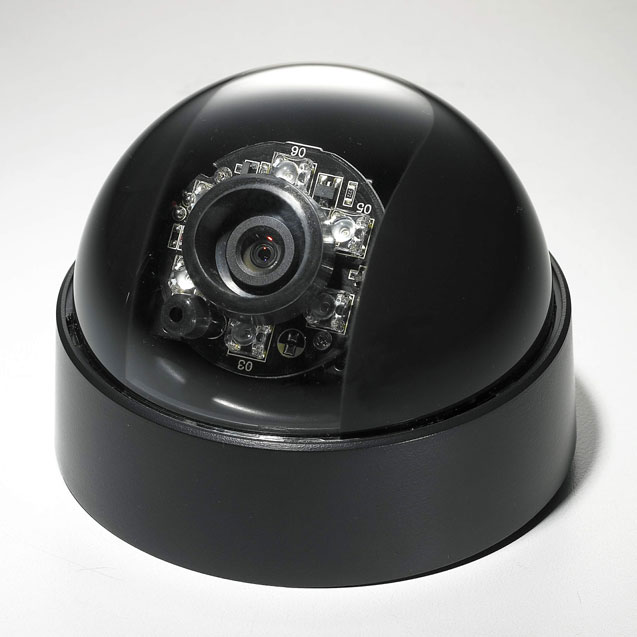
This high quality Everfocus Day/Night Indoor Dome Camera uses infrared light emitting diodes (LEDs) to give you CCTV coverage even in complete darkness. During daytime, it functions as a standard color camera, but when the light level goes below 0.3 lux (about the brightness of the full moon under a clear sky), the camera switches into night mode, which turns on its light emitting LEDs, which will give you a clear picture in black and white even when the room is completely dark.

The IR emitting LEDs will light up the area in front of the camera in 850nm infrared light, a color of light that the human eye cannot see. Only a very slight red glow will be visible to the eye in night mode, but the transmitted image will be clear as day. The illuminators will light up an area in front of the camera up to approximately 40 feet away. The lens in this camera is made of glass, while many no-name import products have hard plastic lenses.

It comes standard with a black mounting base, although can be ordered with a white base if you prefer. A "pigtail" is included in the box to make wiring for power easier. Mounts easily to the ceiling (or wall with optional bracket).

The Everfocus ED200 IR-type day/night security dome camera, with its 380 lines of resolution, is the standard resolution version of this camera and will work for most applications. For a small additional price increase, you can upgrade to the ED300, which is a higher resolution version of this camera, and also features a varifocal lens.

SPECIFICATIONS:

Video Format: NTSC
Picture Element:NTSC: 510 (H) x 492 (V)
Horizontal Resolution: 380 TVL
Video Output: BNC 1.0Vp-p, 75 ohm
S/N Ratio: 48 dB (AGC off)
Auto White Balance: Yes
Gamma Correction: 0.45
Sync Mode: Internal Sync.
IR Distance: 45 feet
Dimensions: 108 (D) x 80 (H) mm / 4.3" (D) x 3.1"(H)
Power Source: 12 V DC + 10%; 6 watts
Operating Temperature: 0°C ~ 50°C / 32°F ~ 122°F
Power Consumption: 280mA (IR on) 100mA (IR off)
Auto Tracing Function: AGC (Auto Gain Control)
ES (Electronic Shutter)
Sensitivity: 0.3 lux/F=1.2 (AGC On) 0 lux (IR Led on)
Lens (optional): 4.3mm, 6mm, or 8mm
IR Life: 20,000 hours
IR Wave Legth: 850nm

Available in Black or White